The Corner Office Cheat Sheet: A CEO’s Guide to Going Viral

CEOs are under a microscope like never before. Ongoing market volatility and deepening social and economic tensions have prompted greater scrutiny of leadership decision making and performance. The concurrent rise in the "CEO brand" as an aligned, but distinct identity from that of the organization has further amplified executive visibility on both a professional and personal level.1
This phenomenon may explain why it feels like we're seeing a lot more cringe CEO moments—tone-deaf remarks, messy weekend behavior, poorly timed PTO, an in-flight faux pas. Just like an old fashioned crisis, how executive leadership responds when a clip or comment goes viral often matters far more than the gaffe itself. But with the entire internet as both judge and jury, the rules have changed.
Forward-thinking leaders need more than a traditional crisis plan. Here's our Corner Office Cheat Sheet…
RULES TO RECOVER BY
Rule #1: Don't Be a Stranger
You might be thinking, "If no one knows who I am, they won't be able to identify me in a video." Au contraire, mon CEO, not in today's world of AI-powered image search. Be honest: What would you rather they find?
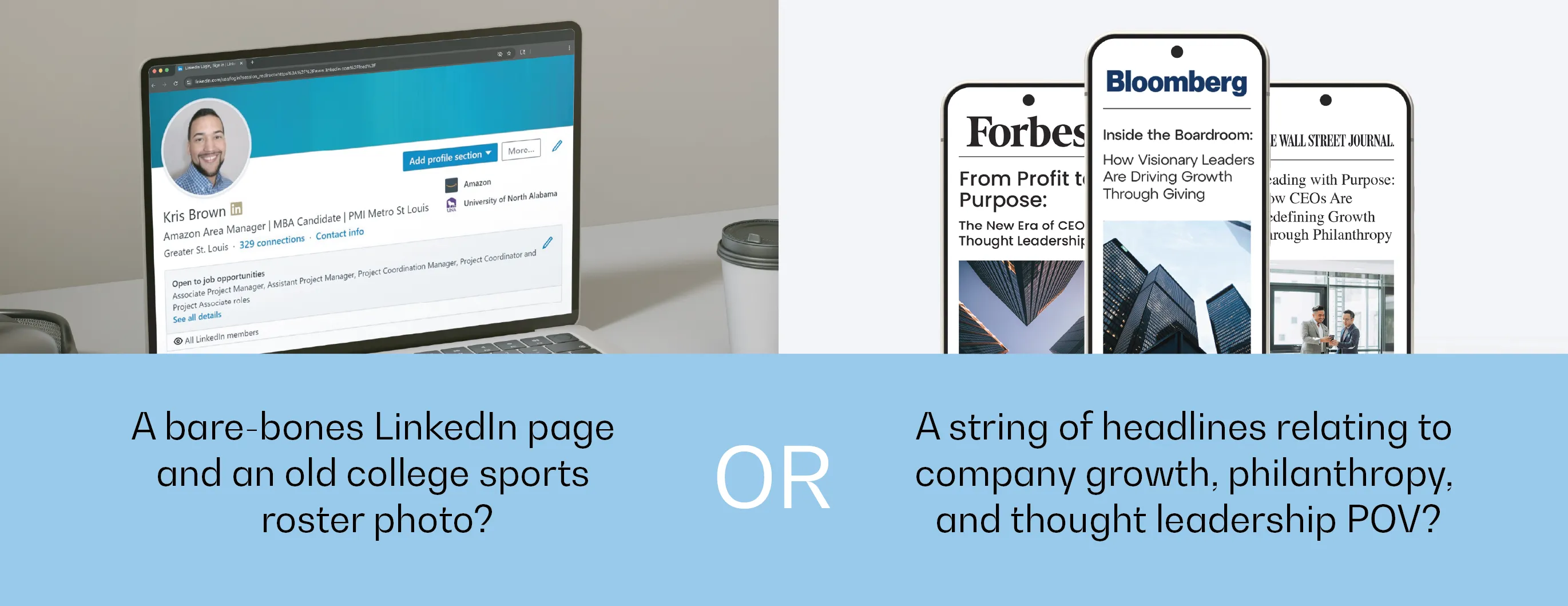
Proactive PR, even if keyed toward spreading awareness of your business and its core differentiators, will help paint you in a positive light (before you go viral). When you're a ghost, people are more inclined to speculate. And you do not want people to speculate.
Pro Tip: Building strong reporter relationships isn't just about being a relevant expert source. If you're known as a CEO that follows through on scheduled interviews, shows up on time, and respects the editorial process, you're more likely to earn an empathetic ear when it hits the fan.

Rule #2: Don't Dawdle
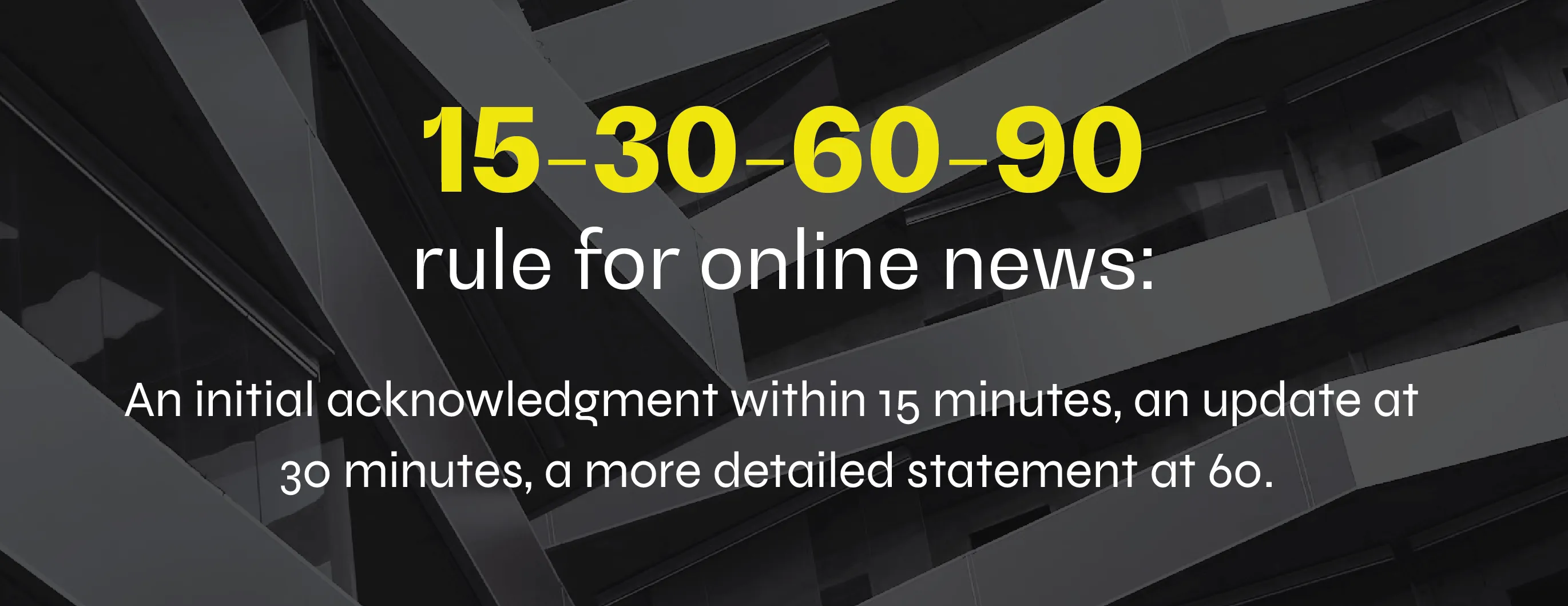
Traditionally, crisis communications followed some version of the 15-30-60-90 rule, which roughly followed the speed of the spread of broadcast or online news.2 An initial acknowledgment should be issued within 15 minutes, an update at 30 minutes, a more detailed statement at 60, and so on. Now, as social media algorithms grow more sophisticated in amplifying high-engagement content, bad behavior goes viral faster than ever. As views and comments mount, a CEOs lack of response can balloon into a firestorm all its own.
Having a pre-set response template or plan in place is helpful, and it's something we recommend to all of our clients as part of a holistic PR strategy. These plans are often focused on highest-likelihood business exposures—such as data breaches, product recalls, or sudden market shocks—so even the most heavily researched, socialized, and considered strategies won't account for every possible eyebrow-raiser. They are, however, a great place to start, because the guidelines for messaging and timing still apply!
So what does that mean for you, Chief Executive Officer? Be ready to act quickly:
- Lead with empathy, honesty, and accountability
- Apologize, if you must, early and often
- Avoid 'spin' and what-about-isms
- Address incomplete context and correct misrepresented facts
- Demonstrate how you will right the 'wrong'
Rule #3: Exercise the Appropriate Communication Channels
Your business' formal crisis communications plan will likely also include considerations for earned media, paid media, and social media, website FAQs, personnel talking points, customer letters, internal memos, etc. These channels all have a time and place—for business related situations. If you find yourself writing an advertorial in the wake of a viral jumbotron video, you might want to take a step back (and maybe dial a public relations specialist…).
Meet your audience where they are.
Do
- Monitor the conversation across platforms to understand the tone of reactions; mirror that when drafting your response.
- Use social media, when appropriate, to respond rather than the traditional statement or press release — a brief, authentic message (video, tweet, or short post) feels more genuine than a polished corporate statement.
Don't
- Respond to every comment trying to defend yourself or the situation
- Over-explain or reassign blame
- Flood your feed with distractions — a barrage of unrelated content looks like you’re hiding.
Rule #4: Have a North Star (or, if you prefer, a moral compass)
You can't please everyone. Ultimately, some keyboard warriors are going to criticize no matter what you do, so it is important that your "CEO brand" has an underlying set of guiding principles. A clear set of values is a reputational through-line—a platform to respond with integrity and confidence rather than scrambling to justify actions in the moment. In practice, these principles might guide whether you choose to comment on a minor viral moment at all, how to handle questions in interviews, or how to interact with stakeholders.
As a business leader, these principles should also be aligned with those of your organization, especially if you're answering to a board. By grounding responses in these shared values—whether that’s transparency, humility, or innovation—you demonstrate that even a misstep is part of a consistent, authentic leadership style.
Remember: It's not just about the incident or even the response. It's about the confidence in your ability to lead the business. The delineation of the CEO brand creates space for distance; resetting on shared principles can help close that gap.
Rule #5: Take a Beat to Reflect
Give yourself time (and grace) as things de-escalate. Treat it like a break-up; your ego is grieving a rejection, and that actually alters your brain chemistry.3 4
If you've followed Rule #4, this should be easier to compartmentalize. Beyond that:
- Consider disabling the comments on your social media posts for a bit, rather than disappearing entirely (see Rule #1) to help gate the trolls
- Embrace opportunities to learn from the arguments on all sides.
- Don't be afraid to make fun of yourself. Self-deprecating humor can help diffuse negativity and hostility.
And when all else fails, hire a PR agency.
Where UpSpring Fits In
As public relations specialists, it's our job to help you get it right. We'll guide you through:
- Strategic timing, i.e. exactly when to reintroduce you into the public conversation, avoiding overexposure while keeping momentum.
- Targeting the media channels that will reach your "needs to hear it most" audience for maximum impact
- Confidence coaching, designed to help leaders regain their footing with authenticity and composure — focusing on tone, delivery, and content
Most importantly, a skilled PR agency will work with you to identify storylines that subtly shift the narrative from cringe to contributions like new initiatives, achievements, or thought leadership to ultimately steer public attention toward the positive.
At UpSpring, our approach to crisis, cringe, and reputation management starts with the positive: brand building for both the business and the CEO on the front end, and when duty calls, serving as your strategic communications partner through the circus.
Due Diligence
We kick off every client relationship with a comprehensive onboarding and discovery process, complete with collaborative brainstorming sessions, one-on-one leadership interviews, and competitor analyses. This process shapes how we articulate brand messaging for both the business and the CEO through storytelling.
Media Training
UpSpring’s Media Training Program is an interactive course designed to equip you with the necessary skills, knowledge, and confidence to navigate all kinds of press opportunities, reporter types, and angles. We'll run you through expectations, mock questions, and AI-assisted role-play exercises to prepare you for real-life interviews—complete with feedback on talking points and areas for improvement. This Program helps ensure you're getting the most out of proactive PR efforts, while prepping you for both cringe and crisis situations.
Crisis Protocol
Our formal crisis communications plans take an in-depth look at a company's challenges and current risks to identify potential pitfalls. We consult with HR, legal, and lower-level management to uncover a broad spectrum of business exposures and concerns. These highly individualized plans outline clear chains of command, prepared statements, and response timelines. For the cringe scenarios we haven't planned for, our built-in Crisis Protocol will give you a roadmap for who to reach out to in a pinch, and create a platform for training, testing, and improvement.
Staging Your Come-Back Tour
Staging a PR come-back tour requires an in-depth knowledge of the current media landscape and a real-time pulse on what's tactful versus what's tacky. At UpSpring, we specialize in our clients' verticals and can provide strategic guidance on how best to rebuild authentically and contextually.
Ultimately, we do our best work when we're with our clients on the ground floor, building the foundation together for your business and its CEO over time through clear and concise messaging. From op-eds and interviews to keynote appearances and social media posts, the UpSpring PR and marketing teams work together to ensure every touchpoint reinforces your company's core values and desired brand perception.