Getting on the Shortlist Is Only Half the Specification

AI is changing the specification process twice.
The first change is becoming visible now. A specifier researching impact-rated windows for a 12-story multifamily tower in Miami can ask ChatGPT which manufacturers belong on the shortlist. Before a representative knows the project exists, the tool can compare Miami-Dade approvals, commercial performance, BIM support, technical documentation, and experience on comparable buildings.
The second change is quieter, and it may matter just as much. Once the architect has chosen a product, they still have to defend that choice to an owner, developer, contractor, or client evaluating it through a different lens. The specifier has to translate performance into risk, sustainability into value, and technical criteria into a decision someone else can approve.
Getting found is only the first half of specification. The second is giving the specifier a case they can carry into the next room.
AI is entering an existing journey
The industry has a habit of treating AI as if it invented product research. It did not. Architects have always narrowed the field before calling a representative. They searched manufacturer websites, reviewed technical literature, consulted colleagues, reused information from earlier projects, looked through specification platforms, and called the people they trusted.
That blended journey remains intact. The AIA's Architect's Journey to Specification found that architects typically consult four to five resources when looking for technical product support. Manufacturer websites are used by 85% of architects, manufacturer technical information by 82%, and online search, including Google, ChatGPT, and forums, by 68%.
AI is becoming another layer across those sources. It can compress the initial research, compare what used to live across multiple tabs, and expose the evidence a manufacturer has made available to the market. It does not decide who is objectively best. It identifies which options it can understand, verify, and connect to the project in front of it.
That distinction matters because AI adoption is moving unevenly. Only 6% of architects regularly used AI for work in the AIA research, but 74% of architects under 35 had experimented with it or used it regularly. Seventy-four percent of architects were optimistic about AI streamlining product research. The direction is clear even if the behavior is not yet universal.
The manufacturers preparing for that direction are not asking which AI subscription the marketing department needs. They are asking whether their product information is complete, structured, current, credible, and available wherever a specifier or an AI tool would reasonably look for it.

The first threshold: making the considered set
For a Miami tower, manufacturers such as YKK AP, Kawneer, WinDoor, ES Windows, and CGI surface because a model can find a substantial trail behind each name. That trail may include Miami-Dade and Florida product approvals, ARCAT specifications, BIM and Revit objects, technical manuals, project experience, testing documentation, distributor information, and editorial coverage.
This is where the difference between visibility and recommendation begins.
Visibility means appearing in the answer. Recommendation means giving the model enough evidence to put the product forward as a credible choice for a particular project. A manufacturer can achieve the first and still lose the second.
A homepage claim about exceptional quality or decades of trust carries little weight without evidence attached to it. AI needs to determine whether the system has been used on comparable projects, whether approvals and test results can be verified, whether the BIM files exist, and whether independent sources substantiate the position the manufacturer claims to hold.
Earned media, technical content, certifications, case studies, specification resources, and structured product data are not separate marketing exercises in this environment. Together, they create the body of evidence from which both people and AI make judgments.
That body of evidence also serves different kinds of specifiers. A rep-first architect wants a knowledgeable local contact. A brand-first architect relies on a trusted portfolio of manufacturers. A sustainability-first architect needs credible environmental documentation. A data-first architect wants complete, comparable information. A digital-first architect expects to self-serve until the moment expert help becomes necessary.
One product page cannot treat those people as if they are asking the same question. AI creates the possibility of serving each one with the evidence that matters to the decision they are making.
The second threshold: helping the specifier win the room
The data on AI-referred traffic helps explain why the second threshold matters. Adobe's analysis of more than a trillion retail visits found AI-referred buyers converting 42% to 54% better than non-AI traffic. Shopify has reported AI-referred sessions converting at nearly 50% higher rates than organic search.
The building-products equivalent is not a purchase button. It is a specifier arriving with a smaller set of serious options and a more developed understanding of why each one belongs there.
That should be an unusually valuable visitor. But most manufacturer websites are built to complete the evaluation, not to prepare the visitor for the conversation that follows it.
An architect does not simply choose a facade system, flooring material, plumbing fixture, or interior finish. They recommend it inside a project team. The owner may care about capital cost and operational risk. The contractor may care about availability and installation. The sustainability lead may care about material health, embodied carbon, or certification requirements. The specifier has to make one product legible to all of them.
The manufacturer that provides only product data leaves that translation to the architect. The manufacturer that translates verified product data into decision-ready evidence makes the specification easier to defend.

FETCH shows what that could look like
FETCH by C2C Certified® is an early example of a website taking on this second job. The chatbot, currently in beta, is designed to live on a product's certification page. It does not exist primarily to help someone discover the product. It helps the designer understand and explain what the certification can substantiate after the product is already under consideration.
Its prompt library makes the intention clear: “Vet a product,” “Finding benefits for my client,” and “The owner is asking for [a health requirement], does this meet that?” These are not discovery prompts. They assume the person asking will need to use the answer with someone else.
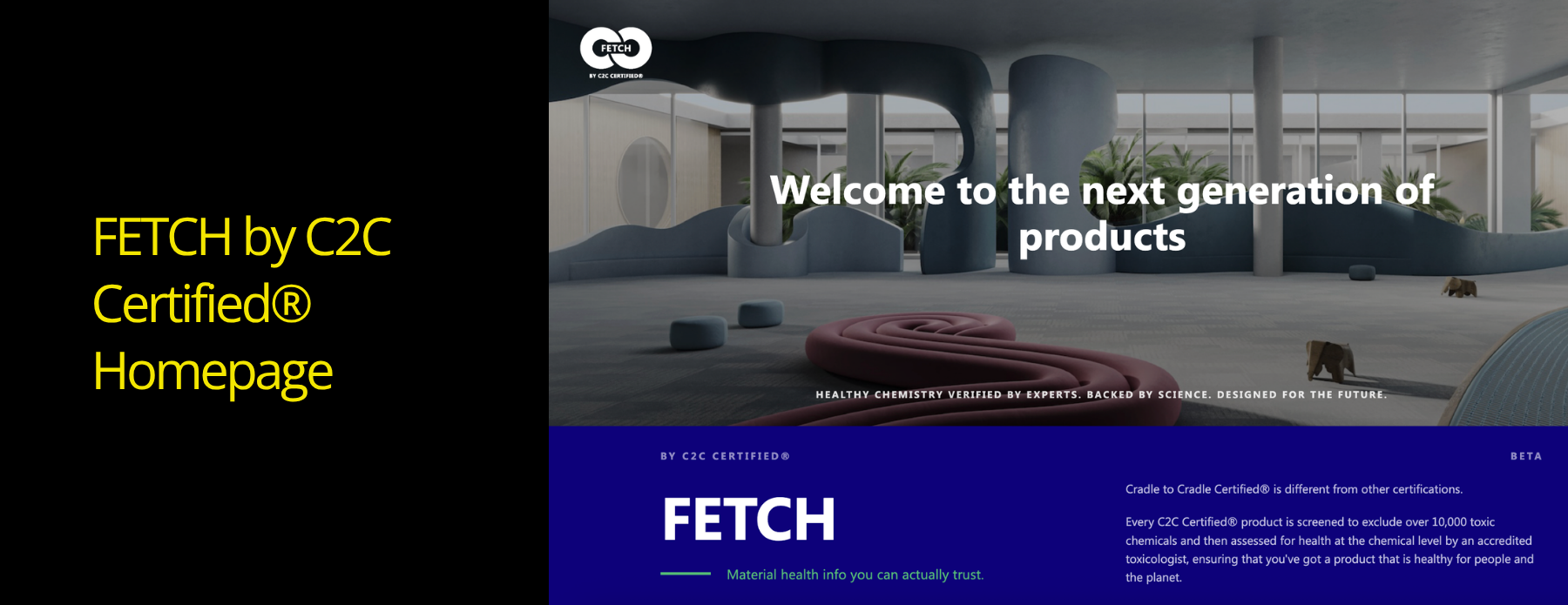
When a designer asks about PFAS, FETCH can provide specific, pre-cleared language about the chemicals restricted in the product. When the question turns to LEED, WELL, or BREEAM, it can direct the user toward tools that translate certification criteria into the frameworks an owner or project team recognizes.
The most important feature is not that the answers arrive through a chatbot. It is the discipline behind them. FETCH is trained to avoid broad claims such as “healthy” or “eco-friendly” when the certification cannot support them. It emphasizes that the information is verified rather than self-reported, reviewed by a toxicologist, and regularly tested for accuracy.
That care recognizes whose credibility is at risk. If a designer repeats an inaccurate claim in a client presentation, the manufacturer is not the only party exposed. The designer is. A tool built to support specification has to be more rigorous than one built to answer a casual product question.
FETCH points toward a different job for the manufacturer website. The site is no longer only a fixed document intended to say the same thing to every visitor. It can become a responsive evidence system that gives one specifier the exact, supportable answer required for one project conversation.
When a designer asks about PFAS, FETCH can provide specific, pre-cleared language about the chemicals restricted in the product. When the question turns to LEED, WELL, or BREEAM, it can direct the user toward tools that translate certification criteria into the frameworks an owner or project team recognizes.
The most important feature is not that the answers arrive through a chatbot. It is the discipline behind them. FETCH is trained to avoid broad claims such as “healthy” or “eco-friendly” when the certification cannot support them. It emphasizes that the information is verified rather than self-reported, reviewed by a toxicologist, and regularly tested for accuracy.
That care recognizes whose credibility is at risk. If a designer repeats an inaccurate claim in a client presentation, the manufacturer is not the only party exposed. The designer is. A tool built to support specification has to be more rigorous than one built to answer a casual product question.
FETCH points toward a different job for the manufacturer website. The site is no longer only a fixed document intended to say the same thing to every visitor. It can become a responsive evidence system that gives one specifier the exact, supportable answer required for one project conversation.
The representative becomes more valuable, not less
None of this removes the representative from the process.
The same AIA research found that deep product knowledge remains a baseline expectation for manufacturer representatives. Architects place additional value on code and compliance expertise, local knowledge, specification assistance, sustainability guidance, and help identifying comparable products that preserve the design intent.
Routine contact without new information carries little value. Consultative support does.
That is the real shift. As websites and AI tools handle more basic retrieval, the representative has more room to do what a static product page cannot: interpret conditions, understand the project, resolve ambiguity, and apply judgment. Digital infrastructure carries the information between meetings. The representative carries the consequence of that information into the project.
Younger specifiers make this especially clear. Their professional habits are digital-first, but their preferences are not digital-only. They still value physical samples, material libraries, and informed human relationships. The strongest specification strategy is not human or digital. It is a coherent system across both.
One evidence system, two outcomes
Most manufacturers still separate PR, SEO, technical content, website development, sales enablement, and AI visibility into different initiatives. The specifier does not experience them that way, and neither does the model helping with the research.
A credible project feature can introduce the manufacturer, support an AI recommendation, give the representative third-party proof, and help the architect defend the choice. A well-structured certification page can answer a search query, substantiate a sustainability claim, and produce language for a client presentation. A BIM object can move the product from research into the model, where it becomes materially harder to replace.
The work compounds when every channel is built from the same evidence system.
That is the specification opportunity in AI. Not simply appearing in more answers. Not installing a chatbot because the market expects one. The opportunity is to build a product position that can be found, verified, understood, and repeated with confidence.
The shortlist determines who gets considered. The evidence determines who gets specified. The case the architect can make determines whether the specification holds.